
After a recent meeting of Union United Methodist Church’s building committee, I became aware of an unsuccessful proposal to replace the church sign along NC Highway 119 N. The recommendation had “fizzled” and been dropped a couple of years before my conversation occurred.
Here’s the situation as I understand it – hopefully in a nutshell:
Like many rural churches, trees and terrain prevent Union UMC from being seen from the highway; to those driving by, the church is “invisible.” The initiative to install a larger, lighted (and admittedly expensive) sign was put forward to address the challenge this reality posed to attracting new members. It failed to pass the (informal?) “cost/benefit analysis” of the Church Council that considered it – probably judged to be more a “luxury” than a “necessity.” I’m certain that the Council acted in good faith and as good stewards, and I’m not trying to make any judgements on this issue.
But it started me thinking (I can almost hear the “Oh, no!” and “Not Again” responses from our members: “Whenever a pastor starts thinking, some poor parishioner usually ends up with more work…”). Two questions came to mind:
First question… Can any church in this day and age afford to be “invisible” from the highway that runs by it?
This is, obviously, a rhetorical question to which the desired answer is, “No!” As the Church Council rightly understood, a new sign would never have been the complete answer to the challenge – even if they had opted for a less expensive sign like this one. 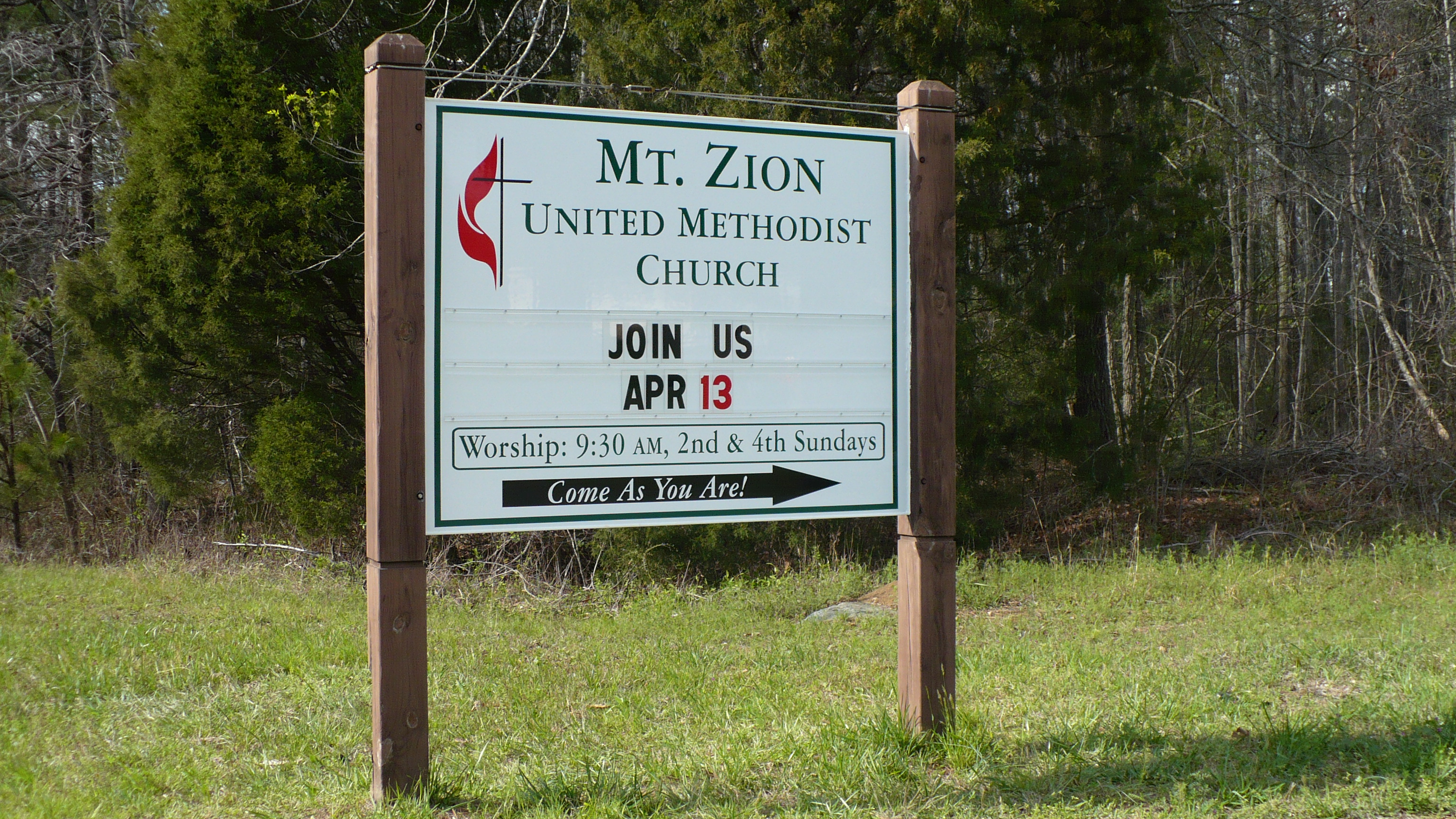 Nor would it ever have been practical to cut down a large stand of trees on property adjacent to the church just to obtain a flattering view from the road.
But the challenge still remains: how can Christians let neighbors or passers-by know that our churches are here, alive, and well? It occurred to me that our ministries are the best evidence of our health and life. When these are relevant and focused outside our walls, others can “see” us. Such visibility leads to life, vitality and (dare we hope?) growth. When our ministries are neither relevant nor outwardly-focused, we remain invisible. And invisibility is a prescription for weakening and death. We may get by without investing in a new sign, but we must invest both our money and our participation in ministries that meet real needs in our community and world. What needs did God bring to mind as you were reading this paragraph? How might our church address those needs?
Next question… Can any church afford to be “invisible” from the “Information Superhighway” that also runs by it?
(Another rhetorical question that hopes for a “No!” answer – there is more than one way to be “invisible”…) Without a presence on the web, those who are seeking what a church may offer will probably never know that we exist. Not “seeing” us, they will use the internet to find other churches, and choose the church(es) to investigate or visit based on what they do “see” on the web. Therefore, I believe that comprehensive, up-to-date church websites increase the likelihood of visitors and ultimately determine the long-range viability of a church. In the 21st Century, an attractive website is critical.
This vital kind of online visibility cannot be achieved or maintained by one person alone. It requires at least one person (and ideally, several people) who will commit to develop the site and arrange to keep it up-to-date. It needs background, current and planning information from every leader of existing groups within the church. Most of all, it depends upon ministries whose stories can inspire people to support and participate. Ultimately, it demands a mindset change from us – challenging every group to plan farther ahead than ever before and to communicate those plans online. That necessary mindset will not be easily developed, particularly in or by people who have not embraced computers or internet technology. I pray that we will rise to the challenge – because our very life as a church may depend on it.
Are you the person who has secretly always wanted to be a journalist or an editor? We need you to help us be seen along the information highway! Do you enjoy taking photos of people and events? We need you to help tell our story online! Are you responsible for any aspect of our church’s organization or ministries? Don’t let us remain invisible; we need your input and support! The details of how God continues to work among us can be shared with a world that needs to see and hear.
I’m hoping that you, too, may now be thinking – and praying – about these questions. I invite you to share your insights about them with me. May God help us become ever more visible to the world around us.
And… May the grace of our Lord Jesus Christ be with you.
“Pastor Bob”

 The Grace Full Word